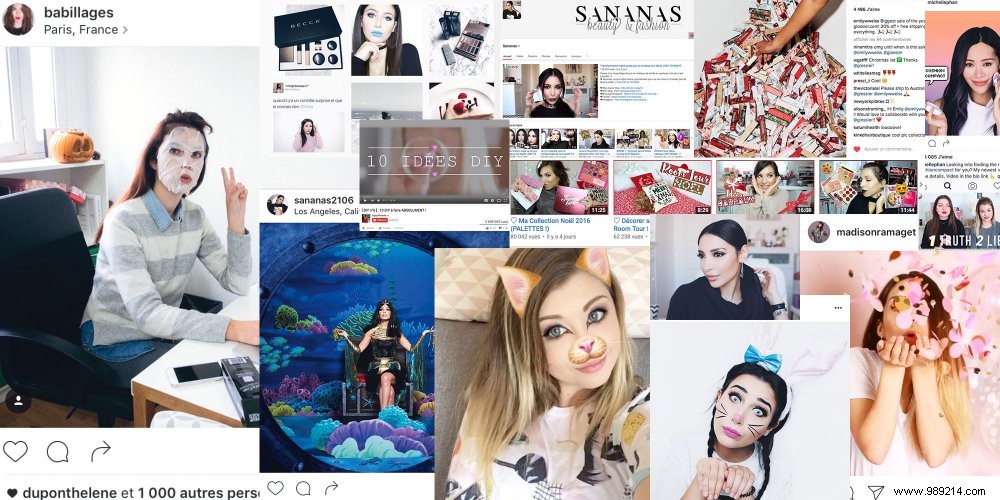
 Influencers like Sananas, EnjoyPhoenix, and Horia command millions of followers on Instagram and YouTube. They test beauty products, share expert advice, and break down the latest trends. How did these young women become key inspirations in the beauty world? How did they build their empires? And what role did social networks play? Let's break it down.
 Imagine runway models sporting dog noses, Bambi masks, or floral crowns—echoing Snapchat filters. This was the scene at New York Fashion Week, where Desigual's show featured MAC-inspired makeup drawn straight from social media vibes. It's clear: beauty and digital platforms are now inseparable, shaping creators' strategies worldwide.
If techniques like contouring and strobing started on fashion runways, beauty bloggers have made them household names, ensuring their lasting appeal.
Especially among younger audiences, these influencers—via blogs, YouTube channels, and social accounts on Snapchat, Instagram, and Facebook—have become the go-to references.
But how did these platforms turn into the ultimate beauty mirrors?
On May 28, 2016, at Paris's Parc Floral, hundreds of excited fans clutched autograph books. Not for reality TV stars, but for the inaugural Get Beauty show, spotlighting France's top beauty bloggers. Stars included Sananas, 27 (1.2 million Instagram followers)(1), Horia, 20 (995,000), and Clara Channel, 17 (948,000). Unknown to many, yet they're beauty's new queens.
Video of the day:The ticket site crashed on launch day from overwhelming demand. Nearly 10,000 tickets sold in minutes—mirroring the U.S. Beautycon event since 2013, where VIP passes fetch $269.99 (€245).
On their blogs and YouTube channels drawing hundreds of thousands—mostly young viewers—they test products, experiment boldly, offer tips, and decode trends.
“With traditional beauty rituals fading, these bloggers' videos and photos serve as portable mirrors,” says body philosopher Bernard Andrieu. “They open up once-intimate spaces of transformation, hidden behind closed doors.”
“We speak casually, as savvy consumers,” shares Beautylicious. “Bloggers bring fresh energy: everyday passionate girls talking to like-minded fans.”
This 30-year-old blogger, running her site for seven years, attracts 300,000 monthly unique visitors and 56,000 Instagram followers.
Unlike many peers who showcase their faces, she stays behind the scenes: “No need to be the star. I focus on info, not tutorials.”
From humble webcam lipstick tests, top influencers have built empires—starting with Americans. Revenues hit €50,000–€150,000 yearly via sponsored posts, brand deals, appearances, plus perks.
Capucine Piot (52,300 Instagram followers) nuances the 'expert' label: “We're curious consumers, not pros. Our popularity lets us test widely and lend credibility brands trust.”
A Birchbox study shows 70% of women follow YouTuber advice religiously; 46% buy recommended products exactly.
“I scour the internet for makeup inspo,” says Léa, 26, graphic designer. “Instagram and Pinterest tutorials have me recreating looks all weekend.”
With terms like 'tutorial,' 'DIY,' and 'routine,' social media has redefined beauty as an interactive lab.
They prescribe trends with runway-level power, popularizing or killing them swiftly.
Contouring—sculpting faces with shadows and highlights—moved from stage makeup to celebs and bloggers.
Google trends tell the tale: late 2014 tutorials surge; mid-2015, Kim Kardashian's take; end-2015 peak searches.
An OpinionWay study for Amazon Beauté Prestige (September) reveals one-third of women source trends online, over one-third mimic tutorials—58% for ages 25-35.
Ethnologist Elisabeth Azoulay, editor of 100,000 Years of Beauty(3), sees digital ritualization as timeless: “Bourgeois mothers passed tips in journals—blogs' ancestors. Brands like Helena Rubinstein ran 'beauty classes' in the 1920s.”
“Now, trust a relatable 'tribe' girl over brands.”
Shirley, 28, optician: “I check hairdressers' Instagram before/afters now—no more blind trust.”
Facing endless new palettes, bloggers guide choices. Capucine Piot's 10-year blog Babillages critiques brands boldly: “Girls need navigation amid cosmetics giants.”
“Boomers mimicked movie stars; we aped pop videos; today's youth? YouTube masters.”
Brands adapted fast. L'Oréal Paris named Swiss Kristina Bazan muse in October.
Maybelline's 2015 EnjoyPhoenix videos (“No gloss?”) racked up 9 million views.
“Brands reach virtual selves via bloggers,” per Bernard Andrieu—unlocking vast markets.
Sephora's Génération Sephora (2013) targets 14-17s with tutorials. Later, a platform for look-sharing and product tagging—pure blogger style.
“Community closeness boosts digital engagement,” says Sephora, focusing Instagram/Snapchat for launches and tips.
Brands mimic to drive sales, Photoshop-style in makeup.
“Network buzz directly lifts store sales,” notes NPD's Mathilde Lion. France's cosmetics dip aside, complexion (+5% concealer, +7% highlighters) and eyebrows (+50% in 3 years) boom—youth-driven recommendations cross generations.
Brands like Too Faced (#TFnofilter 'photo ready') and L'Oréal's selfie-savvy packaging capitalize.
“Networks mirror new beauty ideals,” says Bernard Andrieu.
Snapchat filters spawned uniform looks—an army of mini Kims.
1. Followers at time of writing. 2. #Enjoy by Marie Lopez, Pocket ed. 3. Gallimard collective.
Read also: